

We are a friendly club in Onehunga, Auckland, and we meet fortnightly. Visitors are always welcome — there is nothing to prepare, nothing to pay, and no need to book.
When and where
Every second Wednesday
7:00pm sharp
Please arrive 6:45–6:50pm. Meetings finish by 9:00pm.
Room 7, Onehunga Community House
83 Selwyn Street, Onehunga
(next to Onehunga Primary School)
Get in touch
Maneet Singh
VP Membership
Visiting, joining, or anything you want to know before you come along — email me and I will come back to you.

Onehunga Community House
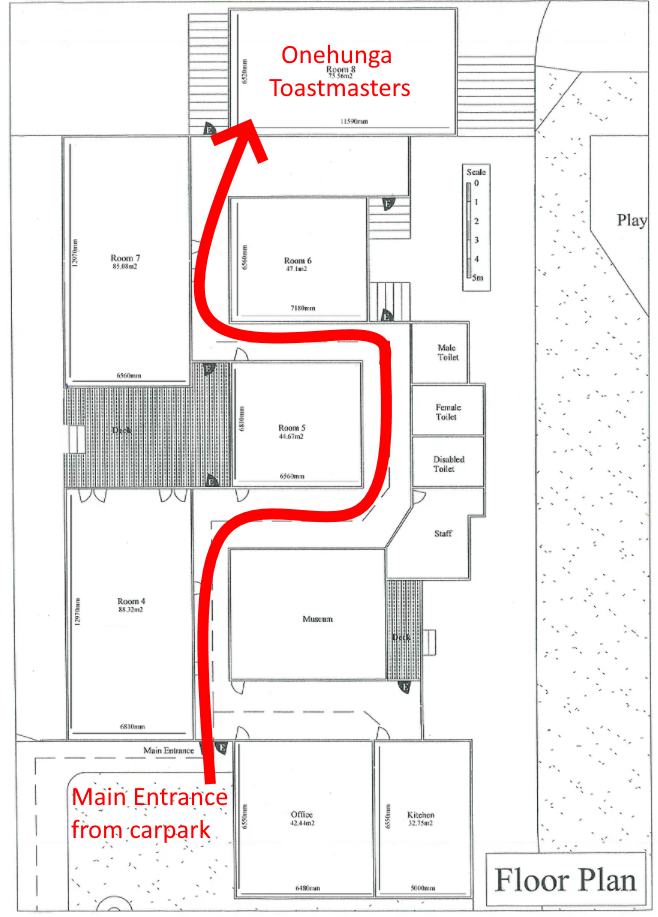
Floor plan — click to enlarge
Finding us — it is a bit of a maze
Enter from the main carpark entrance on Selwyn Street, follow the corridor all the way through past the Museum, up through the building, and Room 7 is on the left. If you get lost, just ask anyone inside — they will point you our way.
What happens at a meeting
Every meeting is run by our own members, and the roles rotate. Over time you will take on most of them — that is where a lot of the learning happens. Here is what each person is doing on the night.
Chairperson
Opens and closes the meeting, sets the theme for the night, and keeps the whole evening moving to time.
Guest Welcome
Looks after visitors. Greets you at the door, sits with you, explains what is coming next, and makes sure you are not left guessing.
Warm-up
Opens the evening with a short, light activity to get everyone in the room talking before the programme proper begins.
Toastmaster of the evening
Hosts the programme. Introduces each speaker, links the segments together, and holds the tone of the meeting.
Table Topics Master
Runs the impromptu speaking segment — a question you have not seen, answered on the spot in a minute or two. It is the hardest thing we do and the most useful.
Timekeeper
Times every segment and signals with coloured cards, so speakers learn to land inside a set time — a skill that transfers straight to work.
Grammarian
Sets a word of the day, listens to how language is used across the evening, and counts filler words — the “ah”, “um”, “so” and “like” that most of us never notice ourselves saying.
Evaluator
Gives one prepared speaker structured feedback: what worked, and one specific thing to try next time. Never criticism — that is not how we do it.
General Evaluator
Evaluates the meeting itself — how it ran, how the other roles were handled, and what the club could do better next time.
As a guest you take none of these roles unless you want to. Most visitors just watch. Some join in at Table Topics — entirely up to you.
Follow us: Onehunga Toastmasters on LinkedIn
Area: M1, Toastmasters New Zealand